Physical Address
304 North Cardinal St.
Dorchester Center, MA 02124
Physical Address
304 North Cardinal St.
Dorchester Center, MA 02124
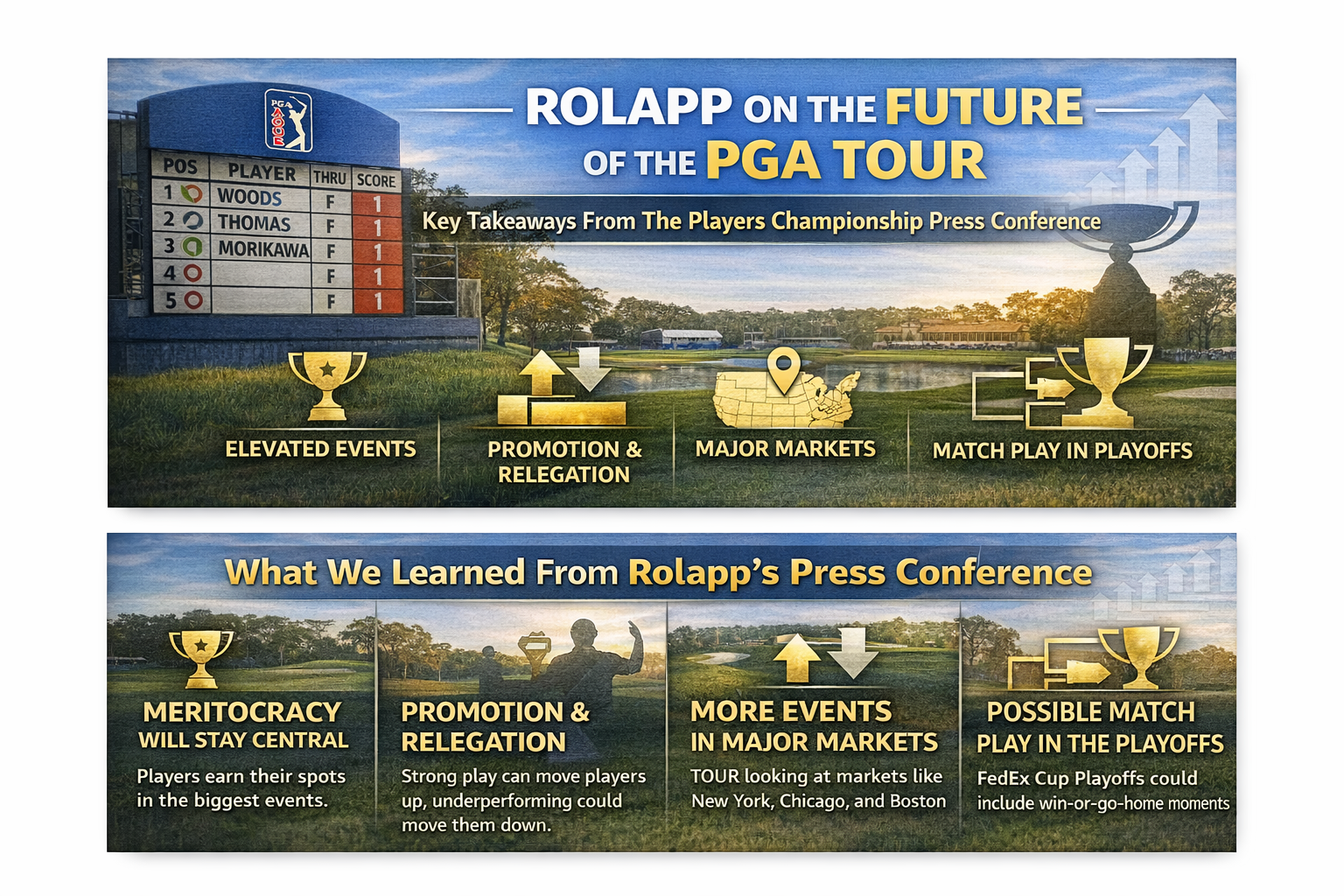
On Wednesday March 11, PGA Tour CEO Brian Rolapp met with media, players, sponsors, and others ahead of The Players Championship, offering the clearest look yet at how the TOUR is thinking about the future of professional golf.
In my earlier post, I broke down the six major themes being discussed by the Future Competition Committee, a player-led group chaired by Tiger Woods.
The press conference offered more details, such as the thinking behind these changes, how the TOUR is collecting feedback, and the belief that the next few years could transform its structure.
Here’s a summary of the main topics covered.
Rolapp began by emphasizing the importance of The Players Championship, describing it as a premier golf event and highlighting strong sponsorship and partner support.
As the new CEO of the PGA TOUR, Rolapp said that listening, especially to players, is one of his main priorities. Planning for the TOUR’s future has included:
Rolapp described this process as:
“Rigorous and highly collaborative.”
The goal is clear yet ambitious: to build the best possible PGA TOUR for players, fans, and partners. Remains the Foundation
Rollapp stressed several times that meritocracy remains the foundation of the TOUR.
Although professional golf has changed significantly in recent years, Rolapp said players often point out that the PGA TOUR’s strength lies in its open, performance-based system.
This idea is guiding many of the proposed changes.
“Players have told me repeatedly that meritocracy is our greatest strength,” Rolapp explained.
Instead of turning into a closed system, the TOUR wants a setup where:
This philosophy directly informs the committee’s consideration of the promotion-and-relegation concept.
The Future Competition Committee, which started in August and is led by Tiger Woods, plays a key role in these ongoing talks.
The committee brings together players and TOUR leaders to examine long-term changes to the competition’s setup.
The committee is focusing on several main areas:
Even though there is early agreement on these six themes, Rolapp said that nothing has been decided yet.
Many of the topics discussed by Rolapp directly support the six main structural ideas under consideration.
The TOUR is thinking about a schedule that would run from late January to early September.
This plan could include 21 to 26 top-level events, such as:
Below that, there would be a second tier of events where players can earn a spot in the top group.
Rollapp also said the committee is considering larger fields of about 120 players.
This would be different from the smaller, no-cut formats used in some recent top events.
The goal is to create:
Another idea discussed was starting the season with a major event at a top venue on the West Coast.
One big advantage:
Finishing events on the West Coast would air in prime time on the East Coast, which could boost TV audiences and get more fans involved.
Rolapp also shared a surprising fact during the press conference.
Right now, the PGA TOUR only holds events in four of the ten biggest U.S. media markets.
This means there are big opportunities in cities lik:e:
Holding events in these cities could greatly expand the TOUR’s reach.
One of the most interesting ideas is a promotion-and-relegation system between tournament levels.
Rollapp compared this idea to leagues like the Premier League, where teams move up or down based on their performance.
If used in golf, it would mean: Strong performance earns entry into elevated events.
Rolapp thinks this approach would make competition even tougher across the TOUR.
The committee is also evaluating potential changes to the FedEx Cup playoffs.
One idea is to add match play elements.
This could create win-or-go-home moments late in the season and add more excitement to the final events, including the Tour Championship.
Rolapp made it clear that these ideas are still under review.
However, the timeline might look like this:
Rollapp stressed that the TOUR wants to get the model right rather than rush the process.
While the press conference was about structural changes, the main message was clear.
The PGA TOUR is working to create a model that:
As Rolapp summed up during the press conference:
“We are proud of our history and just as focused on building the strongest possible future for our game and the fans.”
The Future Competition Committee is still at work, but the talks underway now could shape the PGA TOUR for the next ten years.