Physical Address
304 North Cardinal St.
Dorchester Center, MA 02124
Physical Address
304 North Cardinal St.
Dorchester Center, MA 02124

Q-School remains one of the most unforgiving weeks in professional golf. For a small group of players, it delivers the reward of a full Tour card and a clear path forward. For many more, it determines a new route, often just as viable, but far less specific, through golf’s layered ecosystem of developmental tours.
This year’s PGA Tour Q-School Final Stage and LPGA Q-Series once again highlighted how narrow the margins are at the highest level. A handful of clutch shots created life-changing opportunities, while a missed putt or one bad stretch redirected careers toward the Korn Ferry Tour, PGA Tour Americas, or the Epson Tour.
Understanding Q-School is about more than knowing who earned a card. It’s about understanding what finishing positions mean, how status is assigned, and why missing out doesn’t signal the end, just a different beginning.
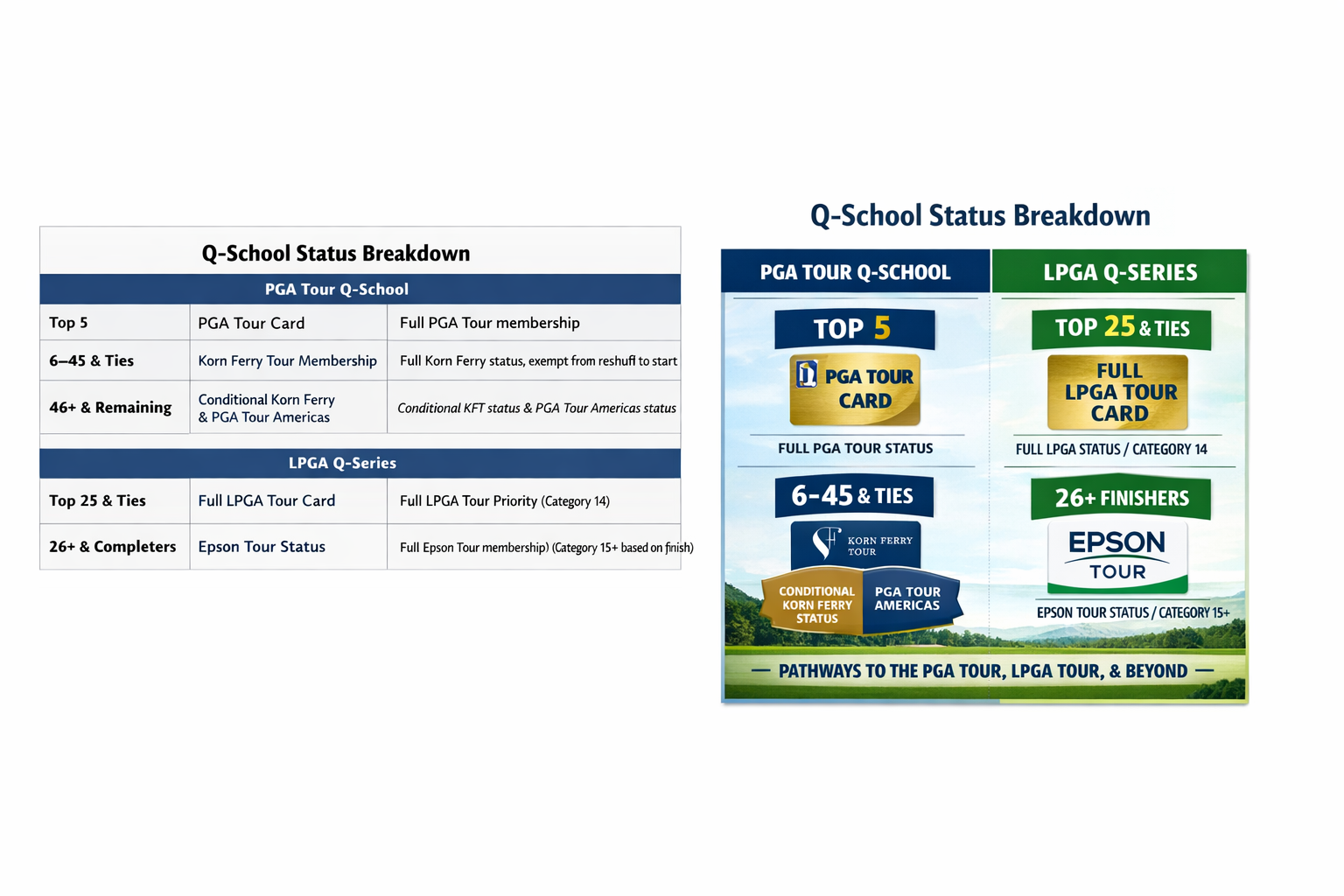
PGA Tour Q-School Final Stage offers one of the toughest pathways in professional sports. Only the top finishers earn full PGA Tour cards, while the remainder of the field is slotted into priority categories on the Korn Ferry Tour.
Unlike past eras, Q-School is no longer a direct pipeline for dozens of Tour cards. Instead, it functions as a pressure cooker where every shot influences not just the following season, but how often a player tees it up, where they travel, and how much opportunity they receive.
Finishing position matters. Players who narrowly miss a Tour card can still emerge with strong Korn Ferry Tour status, while those further down the board may need to rely on reshuffles, sponsor exemptions, or strong early finishes to build momentum.

LPGA Q-Series operates on a priority-ranking system rather than a simple pass-or-fail threshold. Top finishers earn full LPGA Tour status, while others receive conditional status or are placed into priority categories on the Epson Tour.
This system creates a fluid environment throughout the season. Players move up and down priority rankings weekly, meaning a hot start on the Epson Tour can quickly turn into LPGA starts later in the year.
As with the PGA Tour, where you finish matters almost as much as whether you earn a card at all.
| Tour | Finishing Position | Status Earned | Notes |
|---|---|---|---|
| PGA Tour Q-School | Top 5 | Full PGA Tour Card | Guaranteed full-field starts and priority for events |
| PGA Tour Q-School | 6–50 (approx.) | Korn Ferry Tour Category 1 | Higher priority for starts, can compete for the PGA Tour via promotion |
| PGA Tour Q-School | 51+ | Korn Ferry Tour Category 2 | Lower priority, relies on reshuffles and early performance to improve starts |
| LPGA Q-Series | Top 20 (example) | Full LPGA Tour Card | Full schedule access, including majors if qualified |
| LPGA Q-Series | 21–40 | Conditional LPGA Status | Limited starts, may need Epson Tour events to improve priority |
| LPGA Q-Series | 41+ | Epson Tour Status | Priority ranking determines starts; strong performance can promote to the LPGA |
The players who earned full PGA Tour status, A.J. Ewart (first/14 under), Adam Svennson (T2/12 under), Alejandro Tosti (T2/12 under), Marcelo Rozo (T2/12 under), Dylan Wu (T5/11 under), separated themselves in golf’s most stressful setting. Intense closing rounds, steady ball-striking, and an ability to manage nerves proved decisive.
These card earners now enter the season with guaranteed starts, access to full-field events, and a chance to establish themselves early in the FedExCup race. For some, it marks a return after losing status; for others, it represents the realization of a lifelong goal.
What they share is opportunity, something that becomes exponentially harder to find the further down the priority list a player falls.
On the LPGA side, Q-Series produced a mix of first-time cardholders and players reclaiming status after injury, maternity leave, or a down season.
Those earning full LPGA status will enjoy scheduling certainty and consistent competition against the game’s best. Players receiving conditional status may begin the year on the Epson Tour, but the door remains open for rapid advancement through strong early performances.
The LPGA pathway rewards persistence and momentum as much as it rewards a single great week.
Missing a PGA Tour card does not mean starting over. Most players leaving the Final Stage still earn Korn Ferry Tour status, which remains the primary route back to the PGA Tour.
Those finishing higher in Q-School gain better priority, meaning more starts and fewer weeks waiting for fields to open. Lower-priority players must capitalize quickly when opportunities arise, often under even greater pressure.
Others may find themselves competing on the PGA Tour Americas, where strong finishes can lead to Korn Ferry promotion and, eventually, a return to Q-School or direct advancement.
In every case, Q-School acts as a sorting mechanism, placing players on different rungs of the same ladder.
For LPGA hopefuls who fall short at Q-Series, the Epson Tour remains the most reliable path forward. Priority ranking determines starts, but consistent top finishes can quickly elevate a player’s status.
The Epson Tour is more than a consolation prize. It is a proving ground where players sharpen competitive skills, rebuild confidence, and position themselves for future LPGA opportunities.
History shows that many LPGA stars spent significant time on the Epson Tour before establishing themselves at the highest level.
Modern professional golf offers fewer full-field events and less margin for error. Priority ranking determines not only where players compete but also how often.
Better status means more starts, less travel uncertainty, and greater earning potential. Lower status often requires perfect timing, playing well in limited opportunities to earn additional starts.
In this environment, a one-shot swing at Q-School can affect an entire season’s trajectory.
Professional golf rewards resilience as much as raw talent.
Q-School remains golf’s great equalizer: brutal, revealing, and transformative. For a select few, it opens the door to the game’s biggest stages. For many others, it offers clarity, direction, and another chance to climb.
The following season will be shaped not only by those who earned cards but also by those who narrowly missed and now compete with something to prove. Whether on the PGA Tour, LPGA Tour, Korn Ferry Tour, or Epson Tour, the journey continues, and often, the best stories are just beginning.